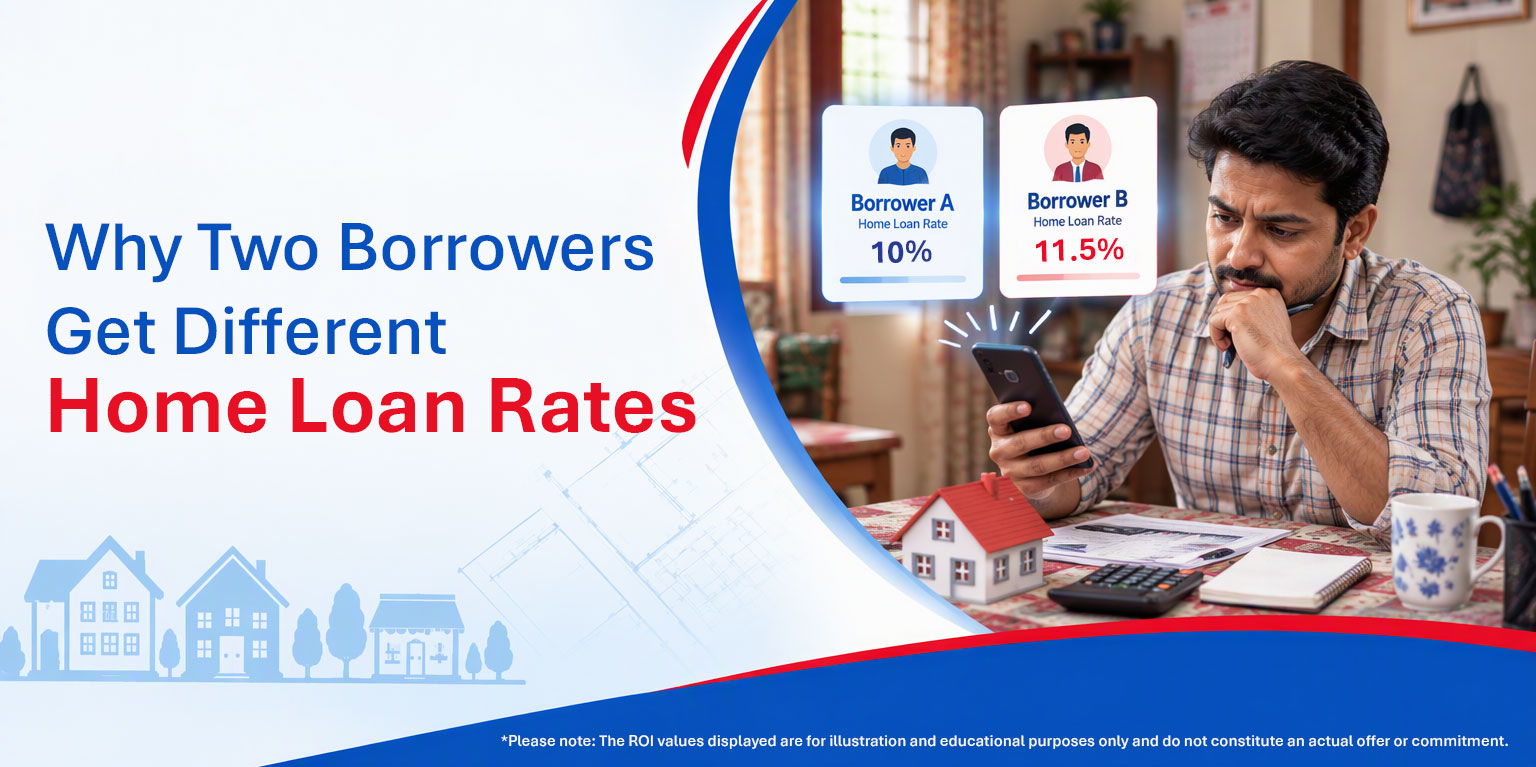
Rakesh works as an accountant at a manufacturing unit in Bhilwara. Rita runs a kirana store nearby. Both of them applied for a ₹25 lakh home loan at the same time frame for almost similar houses, with parallel monthly earnings. Rakesh is offered one rate and Rita has been offered a slightly higher one.
Is that unfair? Not quite. A home loan rate is not a fixed price tag. It is the financial institution’s or the lender’s estimate of how predictable your repayments will be in the span of 15 to 20 years, turned into a number. Once you have an understanding of what goes into that number, you can do a great deal to move it in your favour.
Note : Two borrowers get different home loan rates because lenders add a risk premium (spread) on top of a benchmark rate. That spread depends mainly on (1) whether you are salaried or self-employed, (2) whether your income is fully documented or assessed by the lender, and (3) your credit history and CIBIL score. Loan-to-value, loan amount and the property itself also play a part.
How a home loan rate is actually built - In India, most floating-rate home loans follow a simple formula: Your rate = Benchmark rate + Spread (risk premium)
Benchmark: For banks, RBI requires floating-rate retail loans to be linked to an external benchmark (usually the repo rate) since October 2019. HFCs use their own reference rate, which moves with their cost of funds.
Spread: The part decided by your profile. This is where two borrowers diverge.
The benchmark moves for everyone at once. The RBI raised the repo rate by 25 basis points to 5.50% on 7 October 2026, after holding it at 5.25% through most of the year. When the benchmark moves, both Rakesh’s and Rita’s rates move together. The gap between them comes from the spread, and that is what the rest of this blog explains.
5.50%
RBI repo rate after the Oct 2026 hike
56.2%
Share of India’s workers who are self-employed
13%
New-to-credit share of retail loans, Mar 2026 qtr (down from 32% in 2017)
Factor 1: Salaried vs self-employed -
This is the difference most borrowers notice first. Across banks, HFCs and NBFCs, salaried applicants are usually offered the lowest starting rate, while self-employed applicants often start a little higher. However, a strong credit score can erase the self-employed premium entirely at some lenders. Employment type is a risk signal, not a permanent penalty.
Why lenders price them differently -
What the lender looks at
Salaried borrower
Self-employed borrower
Income pattern
Fixed amount, credited monthly
Varies by season, orders and market cycles
Proof of income
Salary slips, Form 16, bank credits
ITR, GST returns, bank statements, or lender assessment
Verification effort
Low: employer can be confirmed quickly
Higher: business may need a site visit
Income shock risk
Job loss (usually with notice)
Slow season, payment delays, competition
Typical pricing
Lowest starting spread
Slightly higher spread, narrows with strong credit
None of this means self-employed borrowers are riskier as people. India’s workforce is largely self-employed: 56.2% of all workers in 2025 according to the Periodic Labour Force Survey, and 62.7% of rural workers in July–September 2026. Lenders that specialise in this segment have built entire underwriting models around these borrowers, because they repay well when their income is understood correctly.
Factor 2: Documented income vs assessed income
This factor is less talked about, but for many families in semi-urban and rural India it matters even more than employment type.
Documented income Income that can be proven on paper: salary slips and Form 16 for employees; ITRs, audited financials, GST returns and regular bank credits for business owners. The lender takes the figure largely as filed.
Assessed income
Income the lender estimates itself when paperwork does not reflect real earnings. A dairy farmer, a tailor, a tea-stall owner or a small transporter may earn steadily but file no ITR, or file one that understates income. Here, the lender’s credit officer visits the home and business, studies cash flows, stock, customer footfall and bank deposits, speaks to the applicant in a personal discussion, and arrives at a realistic monthly income.
Documented income
Assessed income
Who it suits
Salaried employees, ITR-filing businesses
Cash-based traders, farmers, artisans, gig and informal workers
How income is proven
Salary slips, Form 16, ITR, GST, audited P&L
Field visit, personal discussion, cash-flow and bank statement analysis
Usually higher spread, reflecting assessment cost and uncertainty
Why assessed income costs a little more -
Assessment needs a credit officer to travel, verify and judge, which is a real cost per loan. There is also more uncertainty in an estimated figure than in a filed one. Both get reflected in the spread.
The trade-off is access. Without assessed-income lending, many of these borrowers would get no formal home loan at all, and would turn to informal moneylenders at far higher costs.
The good news: documented income can be built. Filing ITRs for two to three consecutive years, registering under Udyam or GST, and routing business receipts through a bank account can move a borrower from the assessed bucket to the documented one, and that often opens the door to a better rate on a future loan or a balance transfer. Factor 3: Credit history and CIBIL score
Your credit report tells a lender how you have handled loans and credit cards before. Many lenders now price home loans directly on credit score bands.
Low score is not the same as no score
This distinction matters a lot for first-time borrowers:
• Low score (say, below 650): You have a credit history, but it shows missed EMIs, high card usage or settled accounts. Lenders see a pattern they need to price for.
• No score (NH / NA / -1): You have never taken formal credit, so there is simply no record. This is not a negative signal; it is a missing one.
First-time borrowers are becoming rarer in lenders’ books. TransUnion CIBIL data shows the share of new-to-credit consumers in retail loan originations fell from 32% in the March 2017 quarter to 13% in the March 2026 quarter, as many lenders prefer applicants with an existing track record. Specialised HFCs that assess income and character in person remain one of the few routes to a first home loan for this group.
Other factors that shift your rate -
• Loan-to-value (LTV): A bigger down payment means the lender’s risk is lower. Some lenders add a premium when LTV crosses 80%.
• Property and legal title: A clear, approved property with complete papers is priced better than one with gaps in title or approvals.
• Co-applicant: Adding an earning spouse or family member can raise eligibility and, at some lenders, improve pricing. Some lenders also give a small concession to women borrowers.
• FOIR (Fixed Obligation to Income Ratio): If existing EMIs already take up a large share of your income, the new loan is riskier.
What a 1% difference really costs -
Small rate gaps look harmless, but over 20 years they add up. Here is a ₹20 lakh loan for 20 years at three illustrative rates:
Interest rate (illustrative)
Monthly EMI
Total interest over 20 years
Extra vs 9.5%
9.5%
₹18,643
₹24.74 lakh
-
10.5%
₹19,968
₹27.92 lakh
₹3.18 lakh
11.5%
₹21,329
₹31.19 lakh
₹6.45 lakh
Calculated using the standard reducing-balance EMI formula. Rates are examples only and are not Aavas rates.
A one-percentage-point difference adds about ₹1,325 a month and over ₹3 lakh in total interest. That is why it pays to work on the factors you can control.
How to get a better home loan rate
• Check your CIBIL report before applying. Correct errors and close or settle disputes early.
• Pay every EMI and card bill on time for at least 6–12 months before you apply.
• Keep credit card usage under 30% of your limit.
• No credit history? Start small. A secured card or small gold loan repaid on time can create a score within months.
• Self-employed? File ITRs regularly and get your business registered under Udyam or GST.
• Route business income through your bank account so statements reflect real turnover.
• Add an earning co-applicant to strengthen eligibility.
• Increase your down payment to bring LTV below 80% where possible.
• Keep property papers complete before you approach a lender.
• Review your rate after 2–3 years. As your score and documentation improve, ask your lender about a rate revision.
How Aavas looks at borrowers like Rita -
Aavas Financiers was built for exactly the borrowers that standard lending models find hard to read: self-employed, informal-sector and first-time borrowers in semi-urban and rural India. Instead of relying only on documents, Aavas teams meet applicants, visit their homes and businesses, and understand how their income actually flows.
Aavas’ loan book stands strongly on self-employed customers. That experience means a kirana owner, a dairy farmer or a small manufacturer is assessed by people who understand their business, not just by a form.
Frequently asked questions -
Q. Why do self-employed people pay higher home loan interest rates?
Because their income is usually less predictable and harder to verify than a fixed salary, lenders add a slightly higher risk premium. At many lenders this gap is small, and a strong CIBIL score can reduce or remove it.
Q. What is assessed income in a home loan?
Assessed income is the monthly income a lender estimates through field visits, a personal discussion and analysis of cash flows and bank statements, when the borrower’s ITR or other documents do not reflect actual earnings. It is common for traders, farmers and informal-sector workers.
Q. Can I get a home loan without ITR?
Yes. Some housing finance companies, including specialists in affordable housing, offer home loans based on assessed income. The rate may be somewhat higher than for fully documented income, but it gives access to formal credit.
Q. How much does CIBIL score affect my home loan rate?
At lenders that price by score, the gap between the best and lower bands can be 25–45 basis points or more. On a ₹20 lakh, 20-year loan, even 0.5% adds roughly ₹1.6 lakh in total interest.
Q. I have never taken a loan. Will I get a higher rate?
Having no credit history (NH/NA) is different from a low score. Many lenders treat it as a missing signal rather than a bad one, and specialised HFCs assess first-time borrowers on income and repayment capacity.
Q. Can my home loan rate come down later?
Yes. If your credit score improves or your income becomes better documented, you can ask your lender for a rate review. Floating rates also move when the benchmark changes.
The bottom line -
Rakesh and Rita were not charged differently because of who they are. They were charged differently because of how much each lender could see about their income and repayment history. Salaried status, documented income and a strong credit score all make that picture clearer, and a clearer picture earns a lower spread.
If you are self-employed or your income is not fully on paper, the right lender is one that takes the time to understand it. And every ITR filed and every EMI paid on time brings your next rate down.
Disclaimer: This article is intended solely for informational purposes. Any interest rates, ratios, or values referenced are indicative in nature and do not constitute a guarantee. Interest rates and loan terms are subject to change and may vary based on individual eligibility, internal assessments, and the prevailing policies of Aavas Financiers Ltd.
 Give Missed Call for Home Loan +91 9706128128


 PMAY 2.0
 Pay EMI Online
 Download Loan App