 Give Missed Call for Home Loan +91 9706128128

 PMAY 2.0
 Pay EMI Online
 Download Loan App
Special Offers


 Give Missed Call for Home Loan +91 9706128128
 Special Offers

28-Sep-2026 | Home Loan
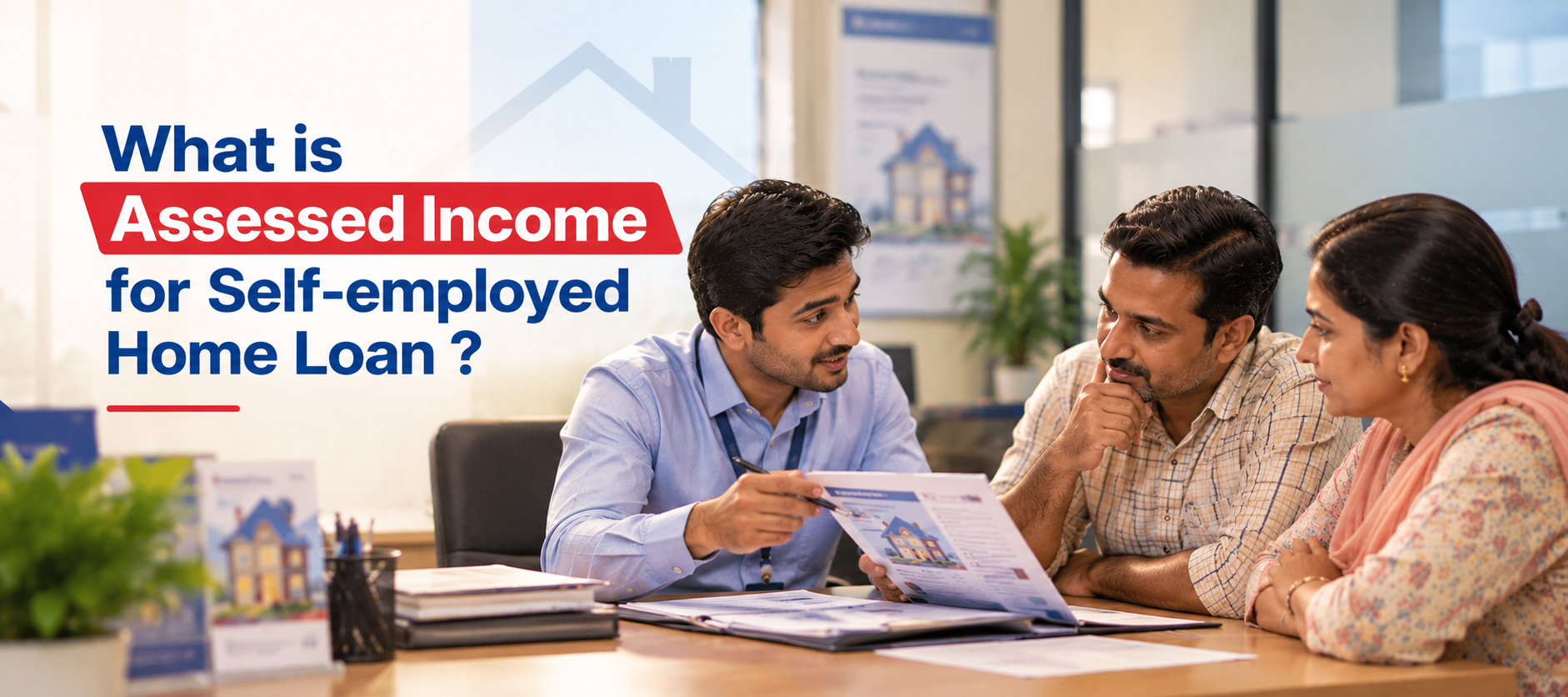
How lenders estimate real earning capacity for traders, shopkeepers and informal-income borrowers who don't have a filed ITR to show.
Ask a bank for a home loan without an ITR, and the conversation usually ends quickly. Yet millions of self-employed Indians — shopkeepers, traders, contractors, artisans, transport operators — run genuinely profitable businesses without ever filing a formal tax return, or with filings that understate their real cash flow. Their income is real. It simply isn't captured on paper the way a salary slip captures a salaried employee's.
Assessed income is the methodology lenders like Aavas Financiers use to bridge that gap. This guide explains exactly what it means, how it's calculated, and what it takes to qualify.
| Assessed income is an income-evaluation method used by Housing Finance Companies (HFCs) to estimate a self-employed borrower's real earning capacity using bank statements, business verification and field assessment — used when formal documents like ITR are unavailable or insufficient. |
Why Assessed Income Exists -
A large share of India's self-employed workforce operates on cash and UPI transactions, without the accounting infrastructure a salaried employee's employer provides automatically. Lenders who insist on ITR as the only proof of income end up excluding a large, creditworthy segment of small business owners — not because their income is inadequate, but because it isn't documented in a familiar format.
Assessed income exists to solve exactly this problem: it looks at what actually moves through a business, rather than what a tax filing states.
Declared Income vs. Assessed Income -
| Aspect | Declared Income | Assessed Income |
| Source | Filed ITR, Form 16, audited accounts | Bank statements, field visit, business verification |
| Who it Suits | Salaried employees, formally registered businesses | Self-employed, informal-sector, thin-file borrowers |
| Accuracy for informal earners | Often understates real cash flow | Reflects actual business activity more closely |
| Used by | Most banks, as primary criterion | HFCs and NBFCs specializing in this segment |
How Assessed Income Is Evaluated -
1. Field Visit and Business Inspection -
A trained credit officer visits the borrower's place of business to understand it firsthand — the nature and scale of operations, how long it has been running, and the general rhythm of trade.
• Nature, scale and duration of the business.
• Estimated monthly sales or turnover.
• Customer footfall, stock levels and visible business activity.
2. Bank Statement Analysis -
Even without a filed ITR, bank statements carry meaningful signal about a business's real cash flow.
• Average monthly credits and deposits.
• Regularity and pattern of transactions.
• Presence of clearly business-related payments.
3. Supporting Business Indicators -
• GST returns, where registered, even if only quarterly summaries are available.
• Utility bills for the business premises.
• Trade licence, shop establishment certificate or udyam/MSME registration.
• Trade references from suppliers or long-standing customers, where relevant.
Assessed income, in practice Aavas's credit team reconstructs a working picture of monthly business income from bank turnover, cash deposits, stock levels and local verification — rather than requiring a single tax document to prove it. |
Who Typically Benefits from Assessed Income Loans -
• Shopkeepers and kirana store owners.
• Small traders — textiles, hardware, electrical goods, agri-inputs.
• Contractors and small civil works operators.
• Transport operators — auto, taxi and small fleet owners.
• Artisans, weavers and home-based business owners.
• Dairy, poultry and other agriculture-linked entrepreneurs.
Advantages of the Assessed Income Approach -
| Advantage | What It Means for the Borrower |
| Inclusion | Access to home finance despite lacking formal ITR |
| Realism | Income evaluated closer to what the business actually earns |
| Dignity | No pressure to inflate or misrepresent income to fit a bank's format |
| Practicality | Uses documents most small businesses already have on hand |
Documents That Support an Assessed Income Application -
Identity & Address -
• Aadhaar, PAN, Voter ID or Passport.
• Recent utility bill or address proof.
Business & Income -
• 6–12 months' bank statements — business and/or personal.
• GST registration and returns, where registered.
• Trade licence, shop establishment certificate or udyam/MSME registration.
• Business address proof — electricity bill or rent agreement for premises.
• Any available ITR — helpful, not mandatory.
Property -
• Title deed and property tax receipts.
• Approved building plan or occupancy certificate, where applicable.
A Few Honest Points to Know -
• Field verification takes a little longer than a straightforward salaried, ITR-based application.
• The assessed loan amount may be more conservative than the business owner's own estimate of income.
• A clean, consistent banking pattern strengthens the case significantly — irregular or erratic deposits work against it.
• Property documentation standards remain the same regardless of how income is assessed.
No ITR? Your Income Still Counts Aavas assesses real business income for self-employed borrowers — bank statements, GST and field verification, not just tax filings. Apply online now → www.aavas.in |
A Word of Caution -
Be wary of anyone offering to fabricate bank statements, GST filings or business records to inflate an assessed income application — this is loan fraud and puts both your property and legal standing at serious risk. Assessed income is a legitimate evaluation of real business activity, not a shortcut around genuine documentation.
Frequently Asked Questions (FAQs) -
Q. What is the difference between declared income and assessed income?
Declared income is what's reported in a filed ITR or formal accounts. Assessed income is what a lender estimates through bank statements, business verification and field visits — often a closer reflection of actual earnings for informal-sector workers.
Q. Can a shop owner get a home loan without any ITR at all?
Yes. Lenders like Aavas evaluate the business directly — through a field visit, bank statement review and available business proof — rather than requiring a filed ITR as the sole basis for income.
Q. Is assessed income accepted by all lenders?
No. Most traditional banks require formal ITR and audited accounts. Assessed income methodology is used mainly by Housing Finance Companies and NBFCs that specialise in serving self-employed and informal-sector borrowers.
Q. Does assessed income mean a lower loan amount?
Not necessarily lower, but often more conservative than a business owner's own sense of their income, since it's based on verifiable indicators rather than self-reported figures.
Q. What documents actually matter most in an assessed income application?
Bank statements showing consistent business turnover typically carry the most weight, supported by GST returns where available and a clean field-verification visit.
Q. Is assessed income available for borrowers in rural areas?
Yes. HFCs with a rural and semi-urban focus, such as Aavas, apply the assessed income approach specifically because a large share of their customer base is self-employed or informal-income earners in these markets.
Final Thoughts -
The absence of a filed ITR does not mean the absence of real income — it just means that income needs to be shown differently. If you run a business with steady, demonstrable cash flow, an assessed income approach lets a lender see your business the way it actually operates, rather than the way a tax form would summarise it. Speak to Aavas about how your specific income can be assessed.
Disclaimer: This article is intended solely for informational purposes. Any interest rates, ratios, or values referenced are indicative in nature and do not constitute a guarantee. Interest rates and loan terms are subject to change and may vary based on individual eligibility, internal assessments, and the prevailing policies of Aavas Financiers Ltd.