 Give Missed Call for Home Loan +91 9706128128

 PMAY 2.0
 Pay EMI Online
 Download Loan App
Special Offers



 Give Missed Call for Home Loan +91 9706128128
 Special Offers

21-Feb-2026 | Affordable Housing
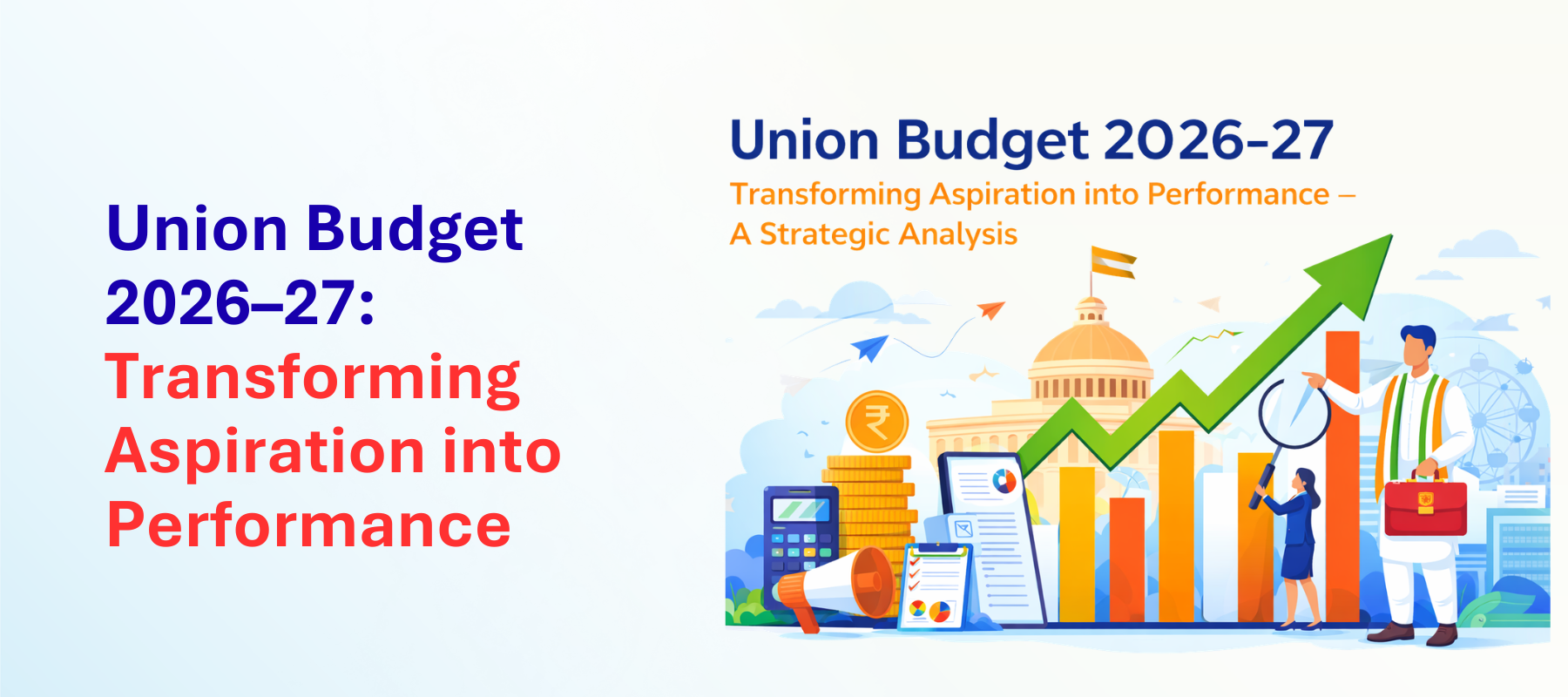
The Union Budget 2026–27, presented by Finance Minister Nirmala Sitharaman on February 1, 2026, marks a watershed moment in India’s economic trajectory. Framed against a volatile global backdrop of supply chain realignments and shifting investment dynamics, this budget is not merely a statement of accounts; it is a blueprint for a high-growth, technologically advanced, and "Atmanirbhar" (self-reliant) India.
Described as a "Yuva Shakti-driven Budget," the fiscal roadmap for 2026–27 emphasizes three core pillars: domestic manufacturing, high-growth services, and infrastructure-led expansion. Here is an insightful breakdown of how this budget aims to transform India's potential into performance.
Finance Minister Sitharaman introduced the "Yuva Shakti" theme, aiming to convert India’s massive demographic dividend into a productive powerhouse. This is guided by three Kartavyas (Duties):
Sustaining Economic Growth: Enhancing competitiveness in a volatile global market.
Building Capacity: Strengthening human capital and institutional skills.
Sabka Sath, Sabka Vikas: Ensuring equitable access to opportunities across all communities.
By focusing on these duties, the government signaled that the 2026–27 fiscal year will prioritize productivity over populism, ensuring that every rupee spent contributes to long-term asset creation.
One of the loudest signals from Budget 2026–27 is the aggressive push to make India a global manufacturing hub. The government has moved beyond traditional sectors to focus on "Frontier Sectors" with high value-add.
With an outlay of ₹10,000 crore, the Biopharma SHAKTI scheme (Strategy for Healthcare Advancement through Knowledge, Technology & Innovation) is set to revolutionize India's biologics and biosimilars production. By establishing three new NIPERs and a network of 1,000 accredited clinical trial sites, India is positioning itself as a global R&D powerhouse.
The India Semiconductor Mission (ISM) 2.0 received an enhanced outlay of ₹40,000 crore, emphasizing supply-chain resilience. Similarly, the electronics component manufacturing scheme's budget was boosted to ₹40,000 crore, aiming to capitalize on the "China Plus One" strategy of global tech giants.
In a bold move to attract hyperscalers and cloud service providers, the Budget introduced a Tax Holiday till 2047 for data center operations. This long-term regulatory certainty is designed to make India the "Data Capital" of the world. By offering tax predictability for foreign companies providing cloud services through Indian infrastructure, the government is ensuring that the "Orange Economy" (creative economy) and AI-driven sectors have the backbone they need to scale.
The budget maintains a massive ₹12.2 lakh crore public capital expenditure. However, the focus has shifted from just "mega-projects" to regional economic agglomeration.
● High-Speed Rail: Development of seven new corridors to connect major growth regions.
● City Economic Regions (CERs): An allocation of ₹5,000 crore per region to unlock growth in Tier II and Tier III cities.
● National Waterways: 20 new waterways to improve logistics efficiency for mineral-rich and industrial clusters.
This strategy ensures that the benefits of infrastructure spend reach beyond the metros, fostering a more balanced national growth profile.
Recognizing MSMEs as the anchors of India's supply chain, the Budget introduced the ₹10,000 crore SME Growth Fund. This fund is specifically designed to identify and incentivize high-potential SMEs, helping them formalize and scale into "Champions." Additionally, the Self-Reliant India Fund received a ₹2,000 crore top-up to ensure micro-enterprises maintain access to risk capital.
Reflecting India's commitment to "Net Zero," the Budget proposed a ₹20,000 crore outlay for Carbon Capture Utilisation and Storage (CCUS). This will focus on hard-to-abate industrial sectors like steel, cement, and chemicals. By investing in CCUS and "Rare Earth Corridors," India is securing the raw materials and technologies needed for a green industrial revolution.
The Budget aims for India to achieve a 10% global share in services by 2047.
● Unified IT Category: Rationalization of taxes for software, ITeS, KPO, and R&D under a single category with a common safe harbour framework.
● The Creative Economy: Establishment of AVGC (Animation, Visual Effects, Gaming, and Comics) Content Creator Labs in 15,000 schools and 500 colleges to train the 2 million professionals needed by 2030.
The tax regime for FY 2026–27 is defined by "Regulatory Certainty." Key highlights include:
● Simplified Income Tax: Modernized forms and rules to reduce compliance complexity.
● Litigation Reduction: Decriminalization of minor offences and trust-based administration.
● Customs Transparency: Incorporation of effective rates directly into the tariff schedule to eliminate ambiguity for importers and exporters.
The Union Budget 2026–27 successfully balances fiscal discipline with an ambitious growth agenda. By prioritizing high-growth sectors like Biopharma, Semiconductors, and Data Centres, while simultaneously empowering MSMEs and the youth, the government has set the stage for India to lead the "Global South."
For investors and citizens alike, the message is clear: India is moving away from being a mere consumer market to becoming a Global Production and Services Hub, powered by Yuva Shakti and institutional reform.
Read More at : India Budget | Ministry of Finance | Government of India