 Give Missed Call for Home Loan +91 9706128128

 PMAY 2.0
 Pay EMI Online
 Download Loan App
Special Offers


 Give Missed Call for Home Loan +91 9706128128
 Special Offers

13-Oct-2026 | Home Loan
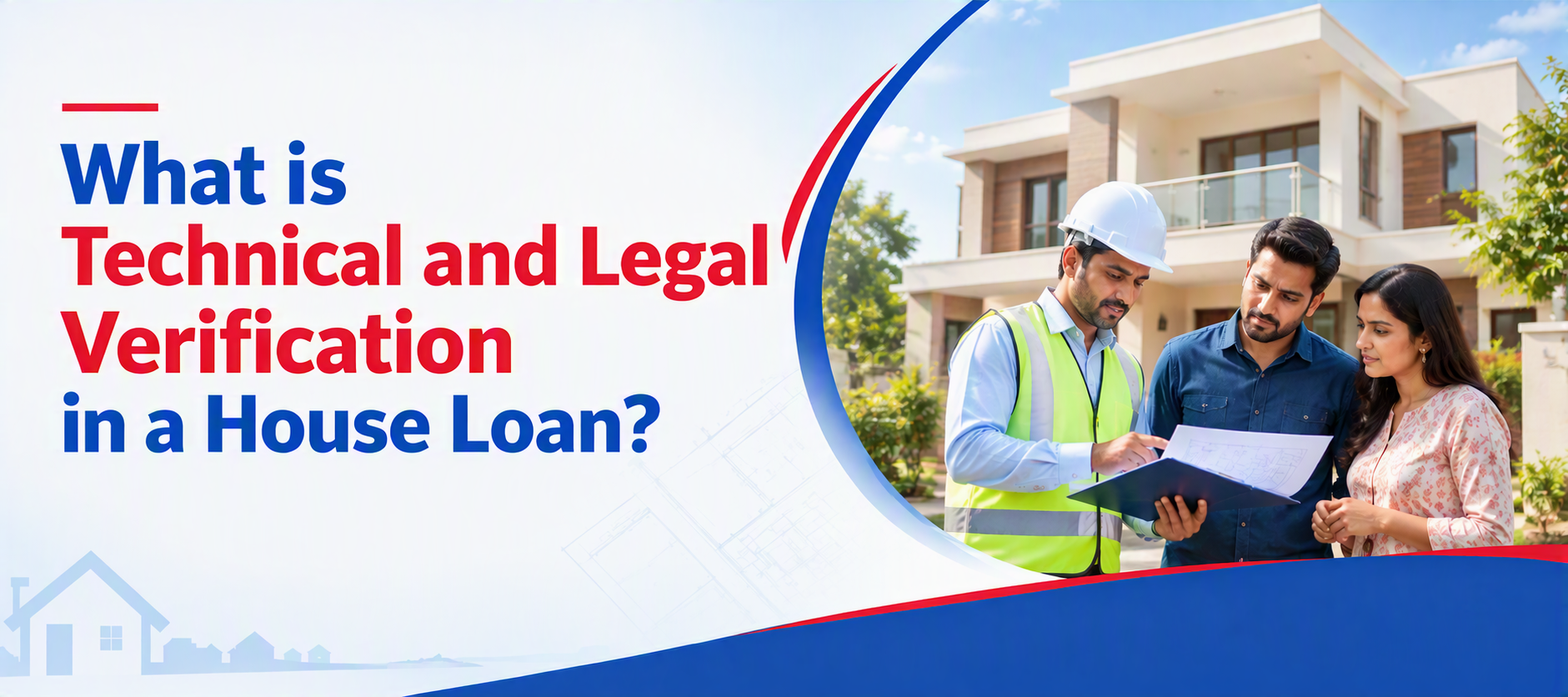
You've submitted your income documents, your credit check has cleared, and then your loan officer says the file is "pending technical and legal." For many first-time borrowers, this is the most confusing stretch of the home loan journey — and often the longest.
These two checks are about the property, not about you. A house loan is secured against the home itself, so before a lender sanctions a single rupee, it needs to know two things: that the property legally belongs to the right person with no hidden claims, and that it physically exists, is built as approved, and is worth the amount being lent. This guide explains both checks, what documents are involved, the red flags that commonly cause delays, and how to prepare.
| Under RBI norms, a home loan cannot exceed 90% of the property's value for loans up to ₹30 lakh, 80% for ₹30–75 lakh, and 75% above ₹75 lakh — which is why the lender's valuation directly decides how much you can borrow. Source: Reserve Bank of India (RBI) — Loan-to-Value (LTV) norms for housing loans |
Why Lenders Verify the Property -
When you take a house loan, the property is mortgaged to the lender until the loan is repaid. If the title turns out to be disputed, or the building is unauthorised or overvalued, the lender's security is weak — and so is your own ownership. Verification protects both sides:
• For the lender: it confirms the collateral is genuine, legally enforceable and worth at least the loan amount.
• For you: it can surface problems — a missing link in the ownership chain, an undisclosed loan on the property, an illegal extra floor — before you commit your savings.
Technical vs. Legal Verification at a Glance -
| Technical Verification | Legal Verification | |
| Who does it | An empanelled civil engineer or valuer | An empanelled advocate or the lender's legal team |
| What it examines | The physical property — location, construction, approvals compliance and market value | The paperwork — ownership chain, encumbrances, approvals and rights to transfer |
| How | Site visit, measurements, photographs, comparison with approved plan and local rates | Document scrutiny, records search, legal opinion |
| Output | Technical / valuation report | Title Search Report (TSR) and legal opinion |
| Key question | Is the property sound, compliant and worth the loan? | Does the owner have clear, marketable title? |
Technical Verification: What the Engineer Checks -
An engineer or valuer appointed by the lender visits the property — usually with you or the seller present — and assesses it against the documents you've submitted. The typical checklist includes:
• Identity and boundaries: that the plot number, address, dimensions and boundaries on site match the sale deed and plan.
• Approved plan vs. actual construction: extra floors, encroachment on setbacks, or built-up area beyond the sanctioned plan are flagged as deviations.
• Construction quality and age: structural condition, visible defects and the building's expected remaining life, which can affect the tenure offered.
• Access and amenities: road access, water, electricity and drainage.
• Land use and zoning: whether the land is permitted for residential use.
• Market value: assessed using comparable local sale rates and the government guideline/circle rate for the area.
| How the valuation affects your loan amount - Many lenders calculate eligibility on the lower of the agreement value and the technical valuation. If you agree to pay ₹20 lakh but the property is valued at ₹18 lakh, the LTV limit applies to ₹18 lakh — and the gap comes from your own pocket. This is also why a realistic purchase price protects you: an inflated deal usually shows up in the valuation. |
For construction and self-build loans -
If you are building on your own plot, technical verification doesn't end at sanction. The engineer first reviews your construction estimate and approved plan, and then visits the site at each stage — foundation, walls, roof, finishing — before each tranche is released. Building strictly to the approved plan keeps these inspections, and your disbursements, on schedule.
Legal Verification: What the Advocate Checks
Legal verification establishes that the person selling (or mortgaging) the property actually owns it and has the right to transfer it, free of claims. The advocate typically reviews:
• Chain of title: the sequence of sale deeds, gift deeds, partition or succession documents showing how ownership passed to the current owner — often traced back over many years, depending on lender policy and local practice.
• Encumbrance Certificate (EC): confirms whether any registered mortgage, loan or charge exists on the property.
• Revenue and municipal records: mutation entries and land records (called jamabandi, khatauni, 7/12 extract or patta depending on the state) and property tax receipts.
• Approvals: building plan sanction, land-use conversion where land was agricultural, and completion or occupancy certificates where applicable.
• For builder projects: RERA registration, project approvals and the builder's title to the land.
• Other rights: validity of any Power of Attorney, society or builder NOC, and whether any litigation is pending.
The outcome is a Title Search Report and legal opinion stating whether the title is clear and marketable, and listing the original documents you must deposit with the lender. Your mortgage is then created and registered with CERSAI, the central registry that records security interests over property.
Buying or Building a Home? Start with Aavas Our teams guide you through the technical and legal checks — so you know what's needed before it holds up your loan.Apply online now → www.aavas.in |
How the Process Works: Step by Step -
| Step 1 — Submit property documents - Along with your KYC and income documents, you share copies of the sale deed or agreement, previous title documents, approved plan and tax receipts. |
| Step 2 — Legal scrutiny begins - The advocate reviews the documents, may search registry records, and raises queries if any link in the chain is missing or unclear. |
| Step 3 — Technical site visit - The engineer inspects the property, compares it with the approved plan and prepares a valuation report. |
| Step 4 — Queries resolved, reports finalised - Any gaps — a missing mutation, an unexplained deviation — are flagged for you to address. Once resolved, both reports are cleared. |
| Step 5 — Sanction and mortgage creation - The loan amount is fixed within the LTV limit. You sign the loan agreement, deposit the original title documents, and the mortgage is recorded. |
| Step 6 — Disbursement - For a ready property, funds are released to the seller. For construction, funds are released in stages after each technical inspection. |
Special Checks by Property Type -
| Property Type | What Gets Extra Attention |
| Resale house or flat | Complete chain of previous sale deeds, society NOC, clearance of existing loans and dues |
| Under-construction builder project | RERA registration, project approvals, builder's land title, construction progress |
| Self-construction on own plot | Clear plot title, approved building plan, construction estimate, stage-wise inspections |
| Inherited or ancestral property | Succession or partition documents, consent of all legal heirs, updated mutation |
| Rural or panchayat-area property | Patta, panchayat and revenue records, local construction permission |
| Land converted from agricultural use | Valid land-use conversion order for residential purpose |
Common Red Flags That Delay or Block a Loan -
• A break in the ownership chain — for example, a previous sale deed that can't be produced.
• Mutation not updated in the current owner's name.
• An existing loan or charge on the property that hasn't been closed.
• Construction beyond the approved plan, or no approved plan at all.
• Agricultural land used for housing without a conversion order.
• Inherited property where one or more legal heirs haven't consented.
• Pending court case or family dispute over the property.
• Large mismatch between the agreed price and the technical valuation.
| A negative report isn't always the end Many issues are curable — a mutation can be updated, a missing document obtained from the registry, a deviation regularised where local rules allow. Ask your loan officer exactly what is required, and resolve it before approaching another lender, since the same property will face the same checks elsewhere. |
How to Prepare Before You Apply -
1. Collect the full chain of title documents, not just the latest sale deed.
2. Get an updated Encumbrance Certificate for the property.
3. Make sure mutation and property tax records are in the current owner's name.
4. Keep the approved building plan handy — and check that the building matches it.
5. For builder projects, verify RERA registration on your state RERA portal.
6. For inherited property, arrange succession documents and heirs' consent in advance.
7. Be present for the site visit so you can answer the engineer's questions.
Documents to Keep Ready -
Ownership & Title -
• Sale deed or agreement to sell, and previous title deeds
• Encumbrance Certificate
• Mutation and revenue records, property tax receipts
• Succession, partition or gift deed (if applicable).
Approvals -
• Approved building plan / construction permission
• Land-use conversion order (if applicable)
• Completion or occupancy certificate (where applicable)
• RERA registration and builder NOC (for builder projects).
For Construction Loans -
• Engineer or architect's construction estimate
• Photographs or progress details for each stage.
Fees and Timelines -
Lenders may charge for technical and legal verification, either separately or as part of the processing fee. Under RBI rules, all such charges must be disclosed upfront in the Key Fact Statement (KFS) you receive before signing — read it carefully and ask about anything unclear. Timelines vary with the property: a clean, well-documented file can be cleared quickly, while missing documents or inherited titles can add weeks.
Frequently Asked Questions (FAQs) -
Q. What is technical verification in a house loan?
It is an inspection of the property by the lender's engineer or valuer to confirm its location, construction quality, compliance with the approved plan and its market value. The resulting valuation helps decide how much the lender can fund.
Q. What is legal verification in a house loan?
It is a review of the property's documents by the lender's advocate to confirm the owner has clear, marketable title with no pending loans, disputes or missing approvals. It results in a Title Search Report and legal opinion.
Q. How long do technical and legal verification take?
It depends on the property and how complete the documents are. Clean files move quickly; missing links in the title chain, inherited property or approval issues can take longer to resolve.
Q. Can my loan be rejected after technical or legal verification?
Yes, if the title is not clear or the property is unauthorised or significantly overvalued. Many issues are curable, though, so ask exactly what needs fixing.
Q. Why is my loan amount lower than expected after valuation?
Lenders often apply the LTV limit to the lower of the agreement value and the technical valuation. If the property is valued below the agreed price, your eligible loan amount falls accordingly.
Q. Do I have to pay for technical and legal verification?
Lenders may charge for these checks. Any such fee must be shown in the Key Fact Statement before you sign, so check it there.
Q. Is verification done again for a construction loan?
Yes. After the initial checks, the engineer inspects the site at each construction stage before releasing the next installment.
Final Thoughts -
Technical and legal verification can feel like paperwork standing between you and your home, but they exist to make sure the property you're paying for is genuinely yours, legally sound and fairly valued. Gather the full chain of documents early, make sure the building matches its approvals, and deal with any gaps before you apply. A well-prepared file is the fastest route to sanction.
Ready to Move Forward? Aavas assesses your full profile and guides you through every property check — for buying, building or extending your home.Apply online now → www.aavas.in |
Disclaimer: This article is intended solely for informational purposes. Any interest rates, ratios, or values referenced are indicative in nature and do not constitute a guarantee. Interest rates and loan terms are subject to change and may vary based on individual eligibility, internal assessments, and the prevailing policies of Aavas Financiers Ltd.