 Give Missed Call for Home Loan +91 9706128128

 PMAY 2.0
 Pay EMI Online
 Download Loan App
Special Offers

 Give Missed Call for Home Loan +91 9706128128
 Special Offers

27-Aug-2026 | Home Loan Eligibility
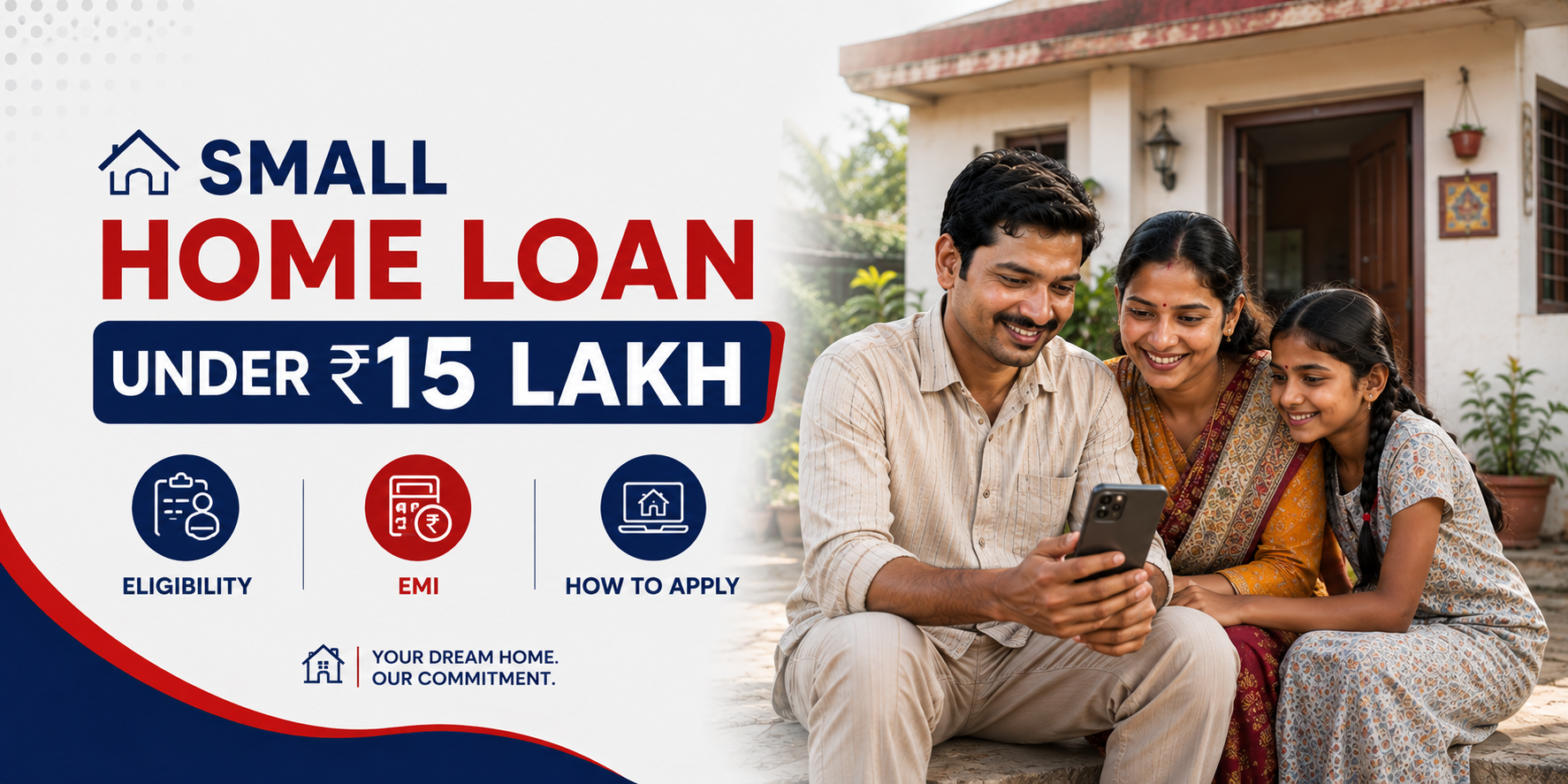
A complete guide for buyers of modest homes and plots in semi-urban and rural India — how loans under ₹15 lakh are assessed, what they cost, and how PMAY can lower them further.
Not every homebuyer is chasing a ₹50 lakh apartment. Across semi-urban towns and rural India, a large share of housing demand is for modest homes, small plots, or basic construction — loans of ₹15 lakh or less. These loans are sometimes treated as an afterthought by larger banks, but they are exactly the segment Housing Finance Companies like Aavas Financiers are built to serve. This guide covers what makes home loans under ₹15 lakh different, how eligibility works at this size, and how to make the process smooth.
A home loan under ₹15 lakh generally qualifies for the highest LTV band — up to 90% of the property value — meaning a smaller down payment is needed compared to larger loans.
Why Home Loans Under ₹15 Lakh Are Different
Loan size changes more than just the EMI — it changes the regulatory LTV cap, the relative weight of fixed costs like processing fees, and often the type of property involved (plots, self-construction, resale homes in smaller towns). Understanding these differences helps you plan realistically rather than applying with assumptions borrowed from large-loan advice.
Loan-to-Value works in your favour at this size
RBI norms cap the loan-to-value ratio by loan slab, and loans under ₹15 lakh sit in the most favourable band.
|
Loan Amount Slab |
Typical Maximum LTV |
Your Minimum Down Payment |
|
Up to ₹30 lakh (includes sub-₹15 lakh) |
Up to 90% |
As low as 10% |
|
₹30 lakh – ₹75 lakh |
Up to 80% |
At least 20% |
|
Above ₹75 lakh |
Up to 75% |
At least 25% |
In practice, most lenders — including Aavas — apply a slightly more conservative LTV even within this band, and also factor in the property's own valuation, condition and location. But the direction is clear: smaller loans require proportionally less upfront cash from you.
Who Typically Needs a Loan Under ₹15 Lakh -
• First-time buyers purchasing a basic home or resale property in a smaller town or village
• Buyers of a residential plot plus construction, or self-constructing a home in stages
• Salaried employees with modest but stable income in semi-urban locations
• Self-employed individuals and informal-sector earners whose overall income is real but assessed differently
• Existing homeowners adding a room, floor or extension rather than buying new
Eligibility at This Loan Size: What Actually Matters -
For a loan under ₹15 lakh, income requirements are considerably lighter than for large-ticket loans. Most lenders look for a stable monthly income in the range of ₹15,000–₹25,000 for salaried applicants, though this varies by lender, location and existing obligations.
What matters most at this size:
• Consistency of income — regular salary credits or steady business cash flow, more important than the absolute number.
• A workable FOIR — since the EMI itself is modest, most applicants comfortably fit within standard FOIR limits.
• Property documentation — clear title is essential regardless of loan size, and can be the biggest source of delay for smaller, older or rural properties.
• Credit history, or the lack of one — a thin file (NH/NA) is common and does not disqualify an applicant with steady income.
Worked Example: EMI on a ₹12 Lakh and a ₹15 Lakh Loan -
At 9% p.a. interest over a 20-year tenure:
₹12,00,000 loan → EMI of approximately ₹10,800/month.
₹15,00,000 loan → EMI of approximately ₹13,500/month.
A borrower would typically need a net monthly income of roughly ₹22,000–₹27,000 to comfortably support either EMI within a standard 50% FOIR limit, assuming no major existing obligations.
PMAY Urban 2.0: Lowering the Cost Further
Loans in this size range are often exactly the profile PMAY Urban 2.0 is designed for. Under the scheme's income-linked verticals, eligible first-time buyers in the EWS, LIG or MIG categories can receive an interest subsidy, which is credited directly to the loan account and reduces the outstanding principal — lowering the EMI for the remaining tenure.
First-time buyers with no pucca house anywhere in India, within the scheme's income limits, may be eligible for a PMAY interest subsidy on top of the loan itself. Combining a small loan amount with a PMAY subsidy can meaningfully reduce the effective cost of homeownership.
Eligibility, income slabs and subsidy mechanics change periodically — Aavas can confirm current PMAY applicability as part of your loan application.
Documents to Keep Ready -
Identity & Address -
• Aadhaar, PAN, Voter ID or Passport.
• Recent utility bill or address proof Income — Salaried.
• Last 3 months' salary slips.
• 6 months' bank statements Income — Self-Employed / Informal.
• 6–12 months' bank statements.
• Business proof or trade documents where available Property.
• Sale deed or title documents.
• Property tax receipts and, for construction, an approved plan where applicable.
How to Apply Online in 5 Steps -
Step 1 — Visit www.aavas.in
Choose the home loan option and open the online enquiry form.
Step 2 — Share your basic details
Enter your name, mobile number, city, desired loan amount and property type.
Step 3 — Submit income and property documents
Share salary slips or bank statements, and basic property documents. Doorstep collection is available.
Step 4 — Verification and PMAY check
Aavas verifies your income and property, and checks your eligibility for any applicable PMAY subsidy.
Step 5 — Sanction and disbursement
On approval, you receive a sanction letter, and the loan is disbursed as per the construction or purchase stage.
|
Small Loan, Full Support Aavas funds affordable homes across semi-urban and rural India — apply online in minutes. Apply online now → www.aavas.in |
Common Mistakes to Avoid -
• Assuming a small loan means minimal documentation — property title checks apply regardless of loan size
• Overlooking processing fees and stamp duty, which form a larger proportion of costs on smaller loans
• Not checking PMAY eligibility before applying, and missing out on an available subsidy
• Choosing too short a tenure and straining monthly cash flow unnecessarily
Frequently Asked Questions (FAQs) -
Q. What is the minimum home loan amount lenders offer?
A. Most HFCs, including Aavas, finance loans well below ₹15 lakh, with no fixed universal minimum. The exact floor depends on the lender's internal policy and the property's value.
Q. Do I need a high CIBIL score for a small loan?
A. A good score helps secure better terms, but loans of this size are often approved with moderate scores or even a thin credit file, provided income is stable and documented.
Q. Can I get a loan under ₹15 lakh without ITR?
A. Yes. Self-employed and informal-sector applicants can be assessed through bank statements and business proof rather than requiring filed ITR, particularly at smaller loan sizes.
Q. Is PMAY subsidy available on loans this size?
A. Often yes — small loans frequently fall within the eligible income and property criteria for PMAY Urban 2.0. Confirm current eligibility and subsidy amount with the lender at the time of application.
Final Thoughts -
A smaller loan amount doesn't mean a smaller opportunity — it often means an easier, faster path to owning a home, with a lower down payment requirement and, for many buyers, an added PMAY subsidy. If you're looking to buy, build or extend a home with a loan under ₹15 lakh, Aavas can walk you through eligibility, documentation and subsidy applicability in one conversation.
Disclaimer: This article is intended solely for informational
purposes. Any interest rates, ratios, or values referenced are
indicative in nature and do not constitute a guarantee. Interest rates
and loan terms are subject to change and may vary based on individual
eligibility, internal assessments, and the prevailing policies of Aavas
Financiers Ltd.