 Give Missed Call for Home Loan +91 9706128128

 PMAY 2.0
 Pay EMI Online
 Download Loan App
Special Offers


 Give Missed Call for Home Loan +91 9706128128
 Special Offers

22-Sep-2026 | MSME
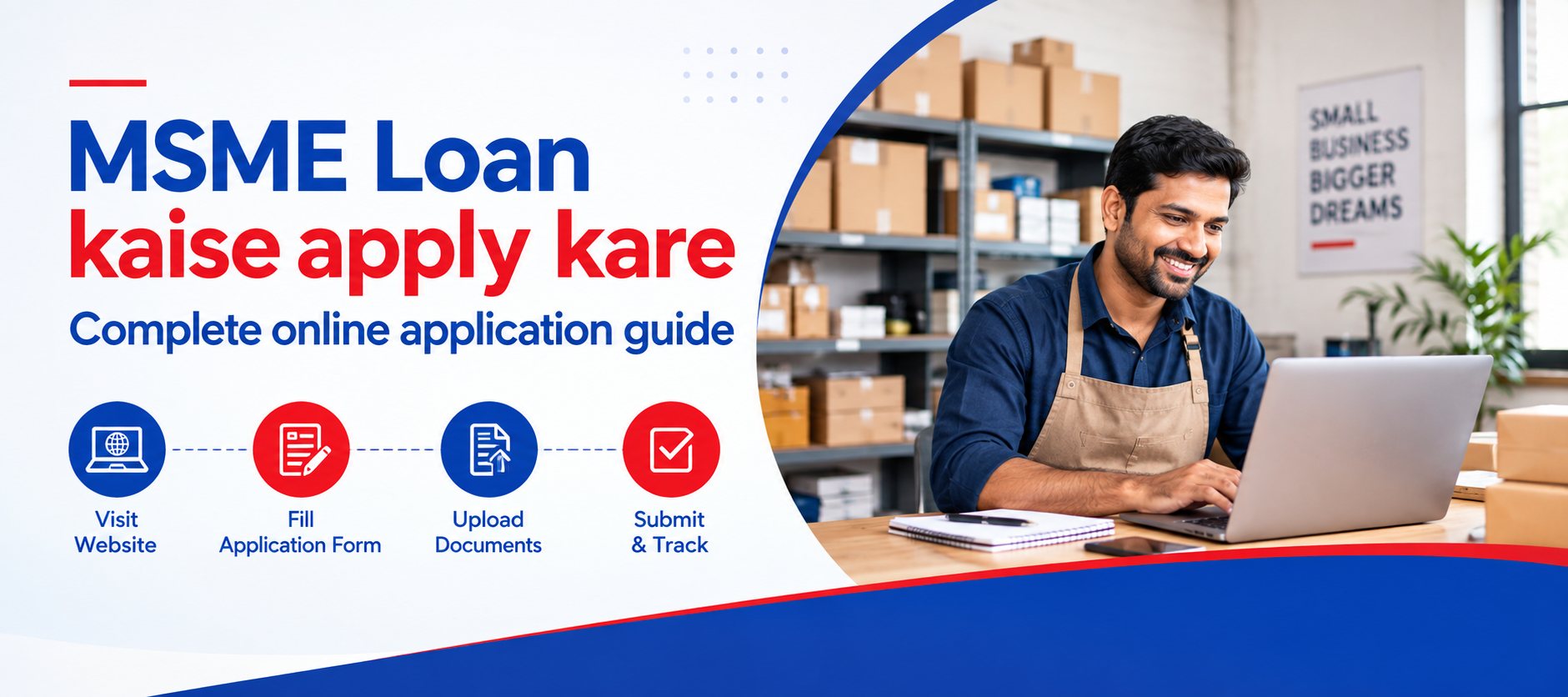
A step-by-step guide for micro and small business owners — Udyam registration, eligibility, documents and the full online application process, explained simply.
Every kirana store, tailoring unit, workshop and small manufacturing setup eventually reaches a point where growth needs capital — new machinery, more stock, a second outlet, or simply steadier working capital between orders. An MSME loan exists for exactly this stage. It is built around your business, not just your paperwork, and today the entire application can be started from your phone.
This guide walks through what an MSME loan actually is, who qualifies, the documents to keep ready, and the exact online steps — including how Housing Finance Companies (HFCs) and NBFCs like Aavas Financiers assess micro and small enterprises with informal or thin financial records.
|
MSME stands for Micro, Small and Medium Enterprises. Classification is decided by the Ministry of MSME based on investment in plant/machinery or equipment AND annual turnover — revised nationwide with effect from 1 April 2025. Source: Ministry of MSME, Notification S.O. 1364(E) |
What Counts as an MSME? The Revised 2025 Classification -
An enterprise must meet both the investment and turnover limit for a category to be classified there. If either figure is exceeded, the business moves up to the next category automatically.
|
Category |
Investment Limit |
Annual Turnover Limit |
|
Micro Enterprise |
Up to ₹2.5 crore |
Up to ₹10 crore |
|
Small Enterprise |
Up to ₹25 crore |
Up to ₹100 crore |
|
Medium Enterprise |
Up to ₹125 crore |
Up to ₹500 crore |
Most home-grown businesses — a single-unit manufacturer, a local
trader, a small services firm — fall well within the micro or small category.
This guide focuses on that segment, since it is where the majority of
first-time MSME loan applicants sit.
Why an MSME Loan Is Different From a Regular Business Loan -
•
Interest rates are generally
lower than unsecured personal or consumer loans, partly due to
government-backed schemes routed through banks and NBFCs.
•
Lenders assess business cash
flow and repayment capacity, not just salary slips — useful for proprietors,
traders and self-employed applicants.
•
Funds can be used flexibly —
working capital, machinery purchase, stock, business expansion or renovation of
business premises.
• Udyam registration, where available, can also unlock priority-sector lending benefits and faster processing with several lenders.
Are You Eligible? Core Eligibility Criteria -
•
Applicant age: generally 21
years at application, up to around 65 years at loan maturity (varies by
lender).
•
Business vintage: most lenders
prefer a minimum of 2–3 years of operational history, though newer businesses
may qualify with a strong co-applicant or collateral.
•
Business type: proprietorships,
partnerships, private limited companies and LLPs engaged in manufacturing,
trading or services are generally eligible.
•
Udyam registration: not always
mandatory, but strongly recommended — it establishes your business formally and
can improve your terms (varies by lender).
•
Financial standing: stable
turnover and a workable credit profile; lenders like Aavas also evaluate
assessed income where formal documentation is limited.
• No history of loan default or a business currently under financial distress.
|
What Is Udyam Registration, and Do You Need It? Udyam Registration is the Government of India's free, fully online system for registering a business as an MSME (msme.gov.in). It requires only your Aadhaar and PAN, and generates a permanent registration number and certificate. Registration itself is not always mandatory for a business loan, but a Udyam certificate is one of the fastest ways to establish business legitimacy, and many lenders factor it positively into the assessment. |
How to Apply for an MSME Loan Online — 5 Steps -
|
Step 1 — Register on the Udyam portal (if not already done) Visit udyamregistration.gov.in and complete the free registration using Aadhaar and PAN. Keep the Udyam certificate handy — it strengthens your application and is asked for by most lenders. |
|
Step 2 — Visit www.aavas.in and choose MSME / business loan Open the online enquiry form and select the business loan or loan-against-property option that fits your requirement. |
|
Step 3 — Fill in your business and personal details Enter your name, mobile number, business type, city, desired loan amount and approximate turnover. Be accurate about your current credit situation and income type. |
|
Step 4 — Speak with an Aavas representative An officer will call to understand your business, review the documentation you can provide, and explain realistic loan terms. Doorstep document collection is available. |
|
Step 5 — Verification, sanction and disbursement Aavas verifies your business, income and any property or collateral offered. On approval, you receive a sanction letter, and funds are disbursed once documentation is complete. |
|
Ready to Grow Your Business? Talk to Aavas We assess your business on turnover, stability and repayment capacity — not just formal paperwork. |
Documents to Keep Ready -
Identity & Address -
• Aadhaar, PAN, Voter ID or Passport of the applicant and co-applicant/guarantor, if any
• Recent utility bill, rent agreement or property document for address proof
Business Proof -
• Udyam Registration Certificate (if registered)
• GST registration certificate and recent GST returns, where applicable
• Shop & establishment licence, trade licence or other business registration documents
• Partnership deed or Memorandum & Articles of Association, for partnerships and companies.
Financial Documents -
• 6–12 months' business and personal bank statements.
• Income Tax Returns for the last 2 years, where available.
• Audited or provisional financial statements, if maintained.
• Where formal statements are unavailable, Aavas evaluates business activity and cash flow directly.
Supporting Documents (Strengthen Your Case) -
• Proof of business address and years of operation (electricity bill, lease, local authority registration).
• Details of existing loans, if any, and repayment track record.
• Collateral documents, where a secured loan is being offered for better terms.
A Word of Caution -
Be cautious of anyone promising guaranteed MSME loan approval without any documentation, or asking for an upfront 'processing fee' before any formal offer is made. Genuine lenders assess your application before quoting terms. Deal only with RBI-registered banks, NBFCs and housing finance companies, verify Udyam registration only through the official government portal, and read the sanction letter carefully before signing.
Frequently Asked Questions (FAQs) -
Q. Is Udyam registration compulsory to get an MSME loan?
Not always — some lenders will assess a business without it. However, a Udyam certificate is free, quick to obtain, and generally improves how your application is viewed, so it's worth completing before you apply.
Q. Can a new business with less than 2 years of operations get an MSME loan?
It is harder, but not impossible. A strong co-applicant, collateral, or a larger down payment can offset limited business vintage with several lenders, including HFCs that assess income directly.
Q. What is the difference between a secured and unsecured MSME loan?
A secured loan is backed by collateral such as property, which usually brings a lower interest rate and higher loan amount. An unsecured loan needs no collateral but is typically limited in amount and carries a higher rate.
Q. Can I apply for an MSME loan with informal or partial financial documentation?
Yes. Lenders like Aavas that serve self-employed and informal-sector borrowers use an assessed-income approach, evaluating your bank statements, business activity and cash flow directly rather than relying only on audited financials.
Q. How long does MSME loan approval usually take?
Timelines vary by lender and documentation completeness. A well-prepared application with Udyam registration, bank statements and business proof ready in advance generally moves faster through verification and sanction.
Q. What can an MSME loan be used for?
Common uses include working capital, purchasing machinery or equipment, stocking inventory, business expansion, renovating business premises, or consolidating existing high-cost business debt.
Final Thoughts -
An MSME loan is designed to grow with your business, not gate-keep it. Registering on Udyam, organising your documents, and being upfront about your business's financial picture will move your application forward faster than any shortcut. If you're ready to explore what's possible for your business, start your application with Aavas Financiers.
|
Ready to Grow Your Business? Talk to Aavas We assess your business on turnover, stability and repayment capacity — not just formal paperwork. |
Disclaimer: This article is intended solely for informational purposes. Any interest rates, ratios, or values referenced are indicative in nature and do not constitute a guarantee. Interest rates and loan terms are subject to change and may vary based on individual eligibility, internal assessments, and the prevailing policies of Aavas Financiers Ltd.