 Give Missed Call for Home Loan +91 9706128128


 PMAY 2.0
 Pay EMI Online
 Download Loan App
Special Offers




 Give Missed Call for Home Loan +91 9706128128
Special Offers

27-Nov-2026 | Home Loan EMI Calculator
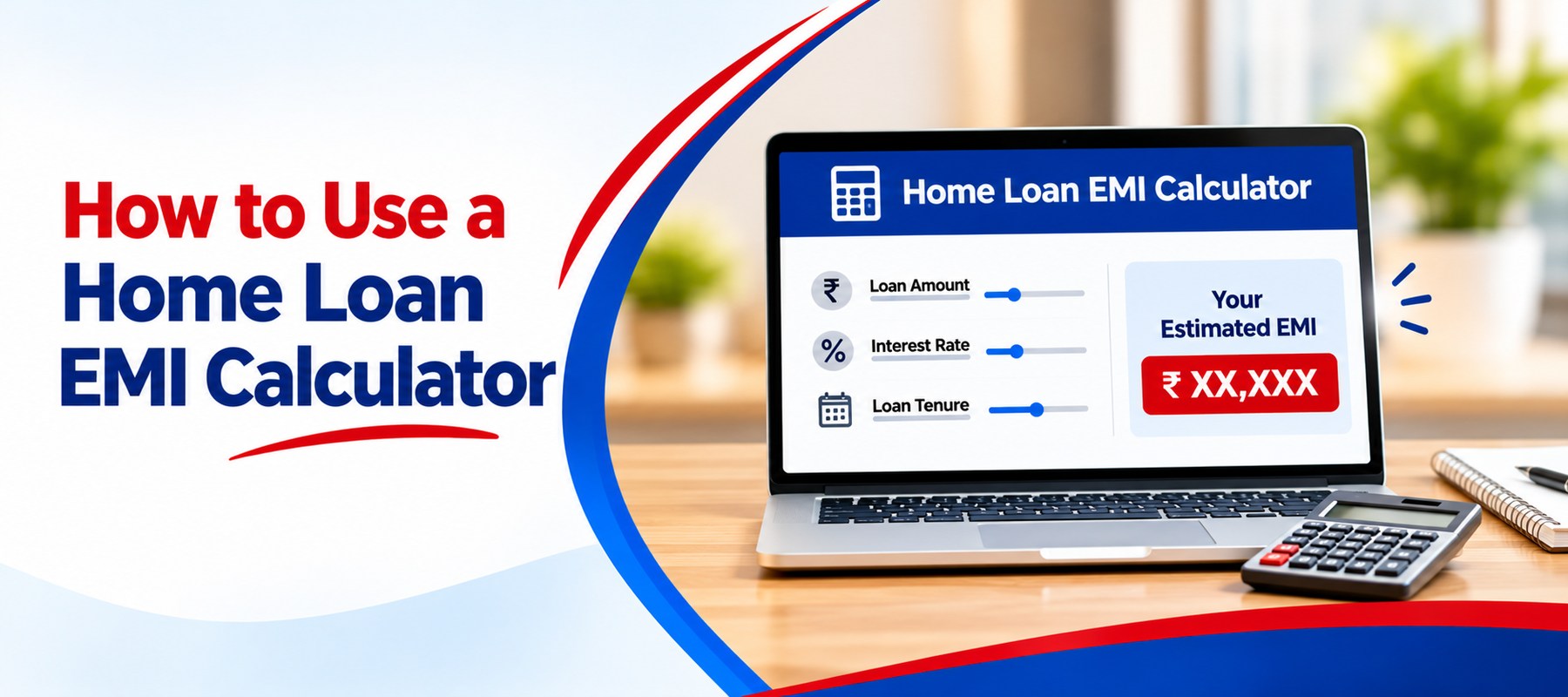
If you want to know how much EMI you would be paying before you apply, this read is for you. Understand how the EMI calculator works, what the numbers mean, and how you can select the correct loan tenure and amount.
| If you want to use EMI calculator, these three things need to be entered in the calculator – amount, tenure, and the interest rate. The EMI calculator will give you instant result i.e. the monthly EMI that you need to pay, exact total amount payable, and the total interest. |
Buying a home is one of the biggest financial decisions you will make. Before you apply for a home loan, the most important question is simple: "How much will I pay every month?"
The EMI calculator helps answer this question within seconds. This will further help in planning your budget, choosing a tenure that can work best for you, and to support in comparing the loan offers before you visit the nearest branch.
What is an EMI?
EMI stands for Equated Monthly Instalment, which is an amount that you are required to pay the lender every month until your loan is fully repaid.
A loan EMI usually has two parts, that is, principal and interest.
First, Principal: This is the part that, when subtracted from your loan, actually reduces your loan amount.
Second, Interest: This is the charge on your loan, and it is called the cost of borrowing, which is calculated on the total outstanding amount.
In the initial years of the loan, the maximum part of the EMI goes towards the payment of interest. As the loan is repaid, a larger part of the EMI goes towards the repayment of the principal.
How to Use a Home Loan EMI Calculator in 4 Steps -
Following are the steps to use an EMI calculator -
• Firstly, you need to enter the loan amount that you wish to borrow from the lender. This amount does not mean the full property price, but the actual loan amount you require. Financial institutions or lenders finance only a certain part of the property, which is called the Loan-to-Value (LTV) ratio, and the remaining amount is paid by you as a down payment.
• Secondly, you need to enter the ROI, that is, the Rate of Interest. This rate defines the annual interest rate that the financial institution will offer you. If you don't have any rate in hand right now, you can enter a rate similar to the prevailing market rates, such as 10%, 12%, or 14%, and see how your EMI changes with a change in the interest rate.
• Thirdly, you have to choose the loan tenure. It is the total repayment period. It can be submitted in months or years. The longer the tenure, the lower the EMI you need to pay. But, on the other hand, the total interest payable will be higher.
• Fourthly, read the results. Once you click submit, the calculator will show you how much monthly EMI you need to pay, the total interest payable, and the total amount payable on the loan you have taken or are planning to take from the lender.
The EMI Formula: What the Calculator Does for You -
Every EMI calculator uses the same standard formula:
| EMI formula - EMI = P × r × (1 + r)ⁿ ÷ [(1 + r)ⁿ − 1] P = loan amount (principal) r = monthly interest rate (annual rate ÷ 12 ÷ 100) n = tenure in months |
Smart Ways to Use an EMI Calculator -
Here are some smart ways that can help you use an EMI calculator effectively -
• First, the most important thing you need to do is find the exact loan amount that suits you. For this, you can work backwards. First of all, you need to think about how much EMI you are comfortable paying. Suppose you are comfortable paying ₹15,000 at an ROI of 9.5% for a total loan tenure of 20 years. So, you can borrow approximately ₹16 lakh. This is how you can try different loan amounts until you get the most suitable EMI.
• Second, you need to check your affordability. The first thing lenders look at is how much of your total monthly income goes towards fixed expenses or fixed EMIs. This is called FOIR (Fixed Obligation to Income Ratio). As per a general thumb rule, you need to keep all your monthly EMIs within the range of 40% to 50% of your total income. However, this exact limit also varies from lender to lender.
• Third, you need to compare the loan offers you are getting from different lenders. Every lender has a different policy and a different way of analysing your profile. So, you need to enter the interest rate offered by each lender and the loan tenure so that you can compare the total interest and the EMI you need to pay. But also remember that there will be other charges, such as processing fees, valuation charges, etc.
What an EMI Calculator Does Not Show -
There are a lot of things that cannot be analysed through an EMI calculator. An EMI calculator is primarily a planning tool that helps you plan your monthly estimated EMI. But there are many things that may differ in the final loan offer.
First, your credit profile - The EMI calculator does not consider your financial repayment history or the total amount of your existing loans. All these factors can impact the ROI, which can also vary from one lender to another.
Second, income assessment - There are multiple factors on which the lender evaluates your total income. These may differ depending on whether you are an employed individual, have an informal income, or are a self-employed person.
Third, LTV and property value - The EMI calculator tells you the estimated value of your loan and the cost of your property. It also helps you understand how much of the total property value, or what percentage of it, a lender is offering as a loan.
Fourth, charges and fees - The EMI calculator basically shows the EMI, but there are other charges, including technical fees, loan processing fees, stamp duty, insurance, etc., that are linked with your loan and that you need to pay.
Fifth, floating rates - If you choose a floating rate for your home loan, your loan tenure or EMI may change as per the lender's revised policy or the impact of changes in the repo rate.
Disclaimer: This article is intended solely for informational purposes. Any interest rates, ratios, or values referenced are indicative in nature and do not constitute a guarantee. Interest rates and loan terms are subject to change and may vary based on individual eligibility, internal assessments, and the prevailing policies of Aavas Financiers Ltd.