 Give Missed Call for Home Loan +91 9706128128

 PMAY 2.0
 Pay EMI Online
 Download Loan App
Special Offers

 Give Missed Call for Home Loan +91 9706128128
 Special Offers

28-Jan-2026 | Home Loan
When you stand at the crossroads of a major financial
decision—whether it’s moving into a new villa or raising capital for your
startup—the terminology can get a bit blurry. Two of the most common products
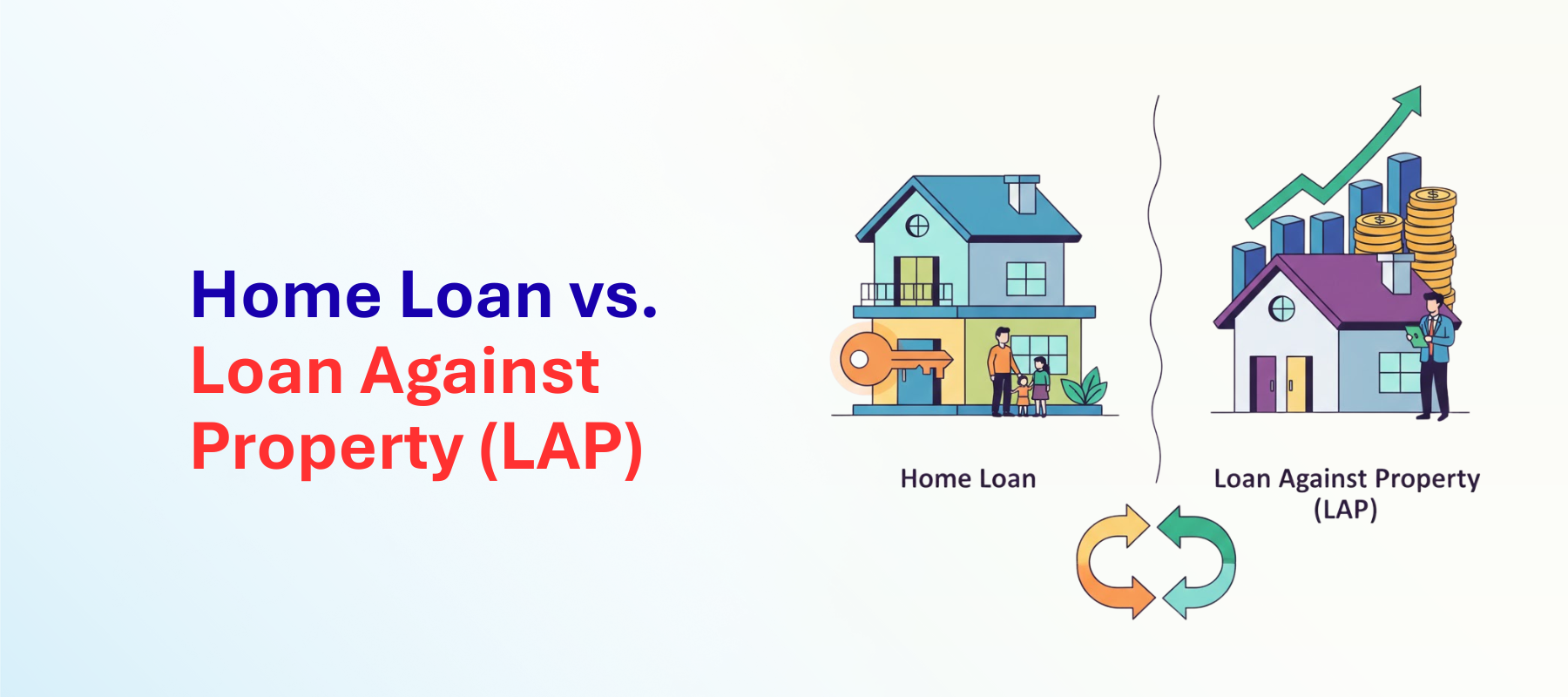
you’ll encounter are the Home Loan and the Loan Against Property (LAP).
To the untrained eye, they both involve a house and a bank. But
in reality, they serve two completely different stages of your life. One helps
you build a dream; the other helps you unlock the value of a dream you’ve
already built.
If you are trying to decide which route to take, here are the
seven critical differences that will determine your long-term financial health.
The most fundamental difference lies in "end-use." A Home
Loan is a purpose-specific credit. The bank gives you money for the sole
reason of buying, constructing, or renovating a residential property. You
cannot take a home loan to fund your child’s education or to buy machinery for
your factory.
Conversely, a Loan
Against Property is a
"multi-purpose" loan. You pledge your existing, debt-free property as
collateral to the bank. Once the funds hit your account, you are free to use
them for almost anything—business expansion, medical emergencies, or even a
destination wedding.
Since a Home Loan is often subsidized by the government to
encourage homeownership and is considered a low-risk "priority
sector" lending for banks, the interest rates are usually the lowest in
the market. Usually rates hover between 9.0% and 15%, which may also increase
or decrease depending upon the applicant’s profile and risk factors.
A Loan Against Property is perceived as a slightly higher
risk by lenders because the funds aren't being used to create a new asset.
Consequently, LAP interest rates are typically 2% to 4% higher than home loan
rates. Before signing the dotted line, it is wise to use a Home Loan EMI calculator to see how even a 1% difference can add a good sum to
your total interest outgo over 15 years.
How much can you actually borrow?
●
Home
Loan: Banks & HFC’s
are generally aggressive here, offering up to 80% of the property’s market
value.
●
Loan
Against Property:
Lenders are more conservative. They usually cap the loan at 50% to 70% of the
property's current market value.
If your property is worth ₹1 Crore, a home loan might get you up
to ₹80 Lakhs for a new purchase, but a LAP might only net you up to ₹60 Lakhs
for your business needs.
Time is your biggest ally or your worst enemy in debt. Home
loans offer the luxury of long tenures, often up to 30 years, which helps in
keeping the monthly installments manageable. You can verify this by playing
with the numbers on a Home Loan EMI calculator.
LAP tenures are significantly shorter, usually capped at 15
years. While this means you become debt-free faster, it also means your monthly
EMI will be higher compared to a home loan of the same amount.
This is where the Home Loan takes a massive lead. Under the
Income Tax Act (Section 24b and Section 80C), you can claim deductions on both
the interest and the principal repayment of a home loan. This can save a
high-income earner up to ₹1.5 Lakhs to ₹2 Lakhs in taxes annually.
A Loan Against Property generally offers no tax benefits
for salaried individuals. However, if you are a business owner and can prove
the LAP funds were used for business purposes, you can claim the interest paid
as a business expense, reducing your taxable profit.
Getting a Home Loan is often faster because banks have
"pre-approved" many projects with builders. However, for a LAP, the
bank must conduct a fresh legal and technical valuation of your existing
property to ensure it is free of litigation and has a high resale value.
To see if you even qualify for these amounts, you should use a Loan eligibility checker. These tools factor in your age, current income,
existing debts (FOIR), and credit score to give you a realistic picture of your
borrowing capacity.
You can get a home loan only for residential properties. You
cannot get a home loan to buy a commercial shop. However, for a Loan Against
Property, usually banks allow you to pledge residential, commercial, or
even industrial property as collateral, provided the title deeds are clear.
|
Feature |
Home Loan |
Loan Against Property (LAP) |
|
Average Interest Rate |
8% - 16% |
12% - 17% |
|
Max Tenure |
Up to 30 Years |
Up to 15 Years |
|
Tax Benefits |
Significant (Sec 80C, 24b) |
Only for business use |
|
LTV Ratio |
Up to 70-80% |
50% - 70% |
|
Primary Goal |
Buying a home |
Liquidity/Business |
Before approaching a bank, do your homework. A Loan eligibility checker is essential
because it prevents you from applying for a loan amount that might get rejected,
which would negatively impact your credit score.
Once you know your eligible amount, use a Home Loan EMI calculator. Don't just look at the monthly EMI; look at the
"Total Interest Payable." You might realize that while the LAP gives
you immediate cash for your business, the higher interest rate and shorter
tenure might put a strain on your monthly cash flow.
Q1. Can I switch my Loan Against Property to a Home Loan?
No. Since the end-use is different, you cannot convert a LAP
into a Home Loan. However, you can "Top-up" an existing Home Loan,
which often carries a comparatively lower interest rate than a fresh LAP.
Q2. Does a Loan Against Property affect my ownership of the
house?
You remain the owner of the property and can continue to live in
it or rent it out. The bank only holds the original title deeds as a
"lien" until the loan is fully repaid.
Q3. Which is better for a startup business—Home Loan Top-up or
LAP?
If you already have an ongoing home loan, a "Top-up"
is almost always better because the interest rate is usually parity with the
home loan rate. If you have no existing loan, a Loan Against Property is your
best bet for large-scale capital.
Q4. Is a credit score important for LAP?
Yes. While the loan is secured by property, banks still check
your repayment history. A score below 700 might lead to higher interest rates
or a lower LTV ratio.
Choosing between a Home Loan and a Loan Against Property isn't about which is
"better"—it's about which fits your current need. If you are building
a nest, go for the Home Loan. If you are sitting on a valuable asset and need
funds to fuel an ambition or handle a crisis, the LAP is a powerful tool to
unlock that "dead" capital.
Always run the numbers through an EMI calculator first. A house
is a home, but it’s also your biggest financial safety net; make sure you use
it wisely.